Tuesday, April 3, 2012

Senator Mark Warner Visits Ashland, Virginia

I had a morning meeting today scheduled with Tom Wulf, president of the Ashland Main Street Association in Ashland, Virginia. Tom sent out a message yesterday that Senator Mark Warner would be in town, as he had a 12:45 speaking engagement at Randolph-Macon College (which is in the heart of Ashland). The Senator was going to be stopping by Ashland Coffee and Tea at noonish, which was also where Tom an I were having our 10:30 meeting. So I thought "Great, I'll meet with Tom, then hang around to meet the Senator."

As it is, reality is a little bit messier than plans for reality tend to be; so as it happened I was walking through town after my meeting with Tom, and I saw the Senator's entourage crossing the streets. I decided to play tag-a-long, and joined up with the group.

Senator Warner seemed to be genuinely enjoying his visit and getting away from the bustle in DC. He did a lot of meets and greets, did some shopping, presented a certificate to Cross Brothers grocery store in honor of their 100th anniversary, and made his way back to Ashland Coffee and Tea.

Cross Brothers Grocery. 100 years and counting. That's 1912 folks!


The Senator took a little time at the coffee shop to chat with folks and take a couple of questions. I don't pride myself on being a journalist, but I did take some notes; so to the best of my recollection, this is some of what was said:

He confided that he had never had a job before where he felt like he did more each week, but by the end of the week there was less tangible evidence for that work. "Do more and get less done" was how he put it.

His main concern was to address the deficit, which he said is tied to restoring confidence to Americans. At this point I don't recall if reducing the deficit is supposed to restore confidence, or that it will take restoring confidence to reduce the deficit. But in either case, they go hand in hand, and one feeds the other in a symbiotic kind of way. (My words, not his).

Interestingly, he said that over the past couple of years, Fortune 1000 companies have done quite well, and they are sitting on 2 Trillion dollars in their balance sheets. In order for things to re-invigorate, they need to re-invest that money.

Each day the deficit is not reduced, it costs Americans 4.5 billion dollars.

Federal spending is currently 25% of GDP, while taxes are only 15%. In order for the economy to be self sustaining, both numbers should be at 20%. (Or in any case, equal. In the past, 20% has been a stable number). As he put it, if you are spending a quarter, but only making 15 cents, you can't sustain that for very long.

Rosanne Shalf, local author of Ashland, Ashland: The Story of a Turn of the Century Railroad Town, inquired what had become of the Gang of Six.
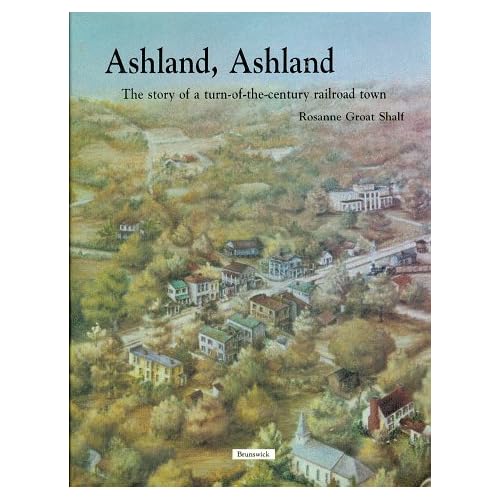
Ashland, Ashland, by Rosanne Groat Shalf

Senator Warner joked that it was now the Hoard of Forty-Five, but was serious in saying that their work continues. As to whatever happened to the Supercommittee, the Senator expressed his frustration that there was not enough time and trust for it to survive. He indicated that it requires a great deal of courage and trust to make big political changes.

He also playfully indicated that Doctors were to blame for the deficit, but then put in the context of greater longevity. As he said "When I was a kid, there were sixteen workers for every recipient of Social Security. Now there are three".

Hanover County Democratic Committee (HDC) chairman Gordon Silver asked if it wasn't true that while the deficit is very large, the total assets of the United States were not magnitudes larger. He compared it to someone who might be paying a couple of thousand dollars for a mortgage loan, yet have hundreds of thousands in equity in their home. Senator Warner agreed that the U.S. has tremendous assets, but that does not relieve the 4.5 billion dollars daily that we are going into debt. As he put it "4.5 billion dollars a day is a lot of money. Even for Ashland".

He indicated that 80% of economic growth is from startup businesses, and that there is a world wide competition for ideas and talent. We have been decreasing infrastructure spending over the past 35 years.

I found the Senator to be warm, with an expressed affection for Ashland. His humor was not dismissive or insulting, and he had a poetic way of looking at things. In his words, everyone has to "give some skin" to "get our swagger back".

I'm sure in years to come I will count my meeting with him as one of life's highlights.

Christian Youth Theater

"C" is for Christian, in my A-Z challenge

I was fortunate to work for CYT Richmond in the Winter and Spring of 2009. My wife, a piano teacher, had gotten a phone call for teaching for CYT. While she was too busy to take on any extra work, I was intrigued by the call. I had already taught technical theater and puppetry for the Ashland Stage Company's after school arts program, and I have been doing storytelling for kids in schools ever since my own boys, now 22 and 25, were in kindergarten. I was part of a storytelling performance troupe, The Wonderland PLayers, in Ashland, VA. And of course I have a lot of experience under my belt as a theatrical set designer and technical director.


From Christian Youth Theater's (CYT) website:

Christian Youth Theater (CYT) is an after-school theater arts training program for students ages 4 - 18. Since its founding in 1981 in San Diego California, CYT has grown to be the largest youth theater in the nation. There are affiliates across the country training thousands of students a year. CYT is a non-profit 501(c)(3) educational organization funded primarily through its tuition, ticket sales and outside contributions.


In the Winter, CYT was working on Narnia. They brought me in to help out with scenery. Some faux finishing techniques, covering some large boulders, and designing trees. All went well, I had a great time, and got paid a decent rate. I wound up designing the sets for their production of Willy Wonka, which is one of the highlights of my career thus far. The experience was spectacular.

CYT is a finely tuned machine. If ever there is a model of how educational theater should be done, this is it. Children pay a tuition to take classes, and when their children are in a show, their parents have to sign up to work on one of the crews. CYT rents adequate shop facilities for scenic construction and costuming, and hires professionals to run each of the crews. However, theaters are rented from local schools and other facilities on a per show basis, and classes are taught in area schools, churches, etc...
They also depend heavily on financial donations.

Crews work for about a month prior to the opening of a show on a weeknight or two plus Saturdays, creating scenery, props, and costumes. The parents I worked with were among the most delightful crews I've ever worked with, with a real passion for excellence. There were well over 20 people working on the sets, eager to understand my designs and execute them to my standards. I also had some of Richmond's top notch scenic artists working with me, resulting in a scale of achievement that astounded me.

Here are some pictures of the set design:

The Wonka factory in the background with city skyline, and the Bucket Shack in the foreground. Design inspired by architecture of Richmond, Virginia, including the defunct Lucky Strike warehouse.


Bucket Shack rotates to reveal interior, with "funhouse" style bed.

Chocolate River Room with Tim Burton inspired Candy Canes, flower umbrellas, and fabric waterfall
Physical model of set


Construction of Wonka Factory. Wings swing inward to become stairs.

You can see photos of the actual show by going to CYT Richmond's website gallery and clicking on Willy Wonka.

I was amazed that not only was a stage full of (at times) almost a hundred kids not a mess of chaos, but that the show was among the best live theatrical performances I've seen.

CYT is an exemplary case of outstanding arts management, quality education, great entertainment, and cooperative creation. Any arts organization would do well to study the example they have set.

Here's a video from Youtube of their closing number:


"C" is for Christian Youth Theater, and April is Parkinsons Awareness Month

Monday, April 2, 2012

Business and Art

Or Art and Business. I had to come up with a "B" post on my A-Z challenge.

There's an old saying:

"Lack of planning on your part, does not constitute and emergency on my part".

Often, artists are approached to donate their creations or services on behalf of charities for fundraising purposes. Often the artist is told that "we don't have the money to pay you". However... the donation is intended to procure what the the requestor is lacking... money.

A prevailing mindset assumes the donation of free goods, which then can be actioned off, with opening bids starting at zero. I hold that this meme is a broken one.

The largest non-profits organizations know that it takes money to make money. There is a reason why CEO's of the charities make salaries in the hundreds of thousands of dollars. They know how to raise money. Their salaries are investments.

This same mindset should be applied to any not-for-proft. Being a not-for-profit is not an excuse to have a bad business plan. Like any business, money earned should be based on cost of goods, plus markup. So rather than thinking first and foremost of asking an artist to donate their time or creations, ask them what their non-profit rate it. Then when you are going to auction their work, put the starting bid at whatever you paid.

If you don't have the cash in pocket, pay it on the back end when the item sells. If it doesn't sell, it goes back to the artist.

As for the artist, evaluate every request for donations. I'm not telling you not to be a volunteer, or not to donate your time. But the more money you make, the more time you will have to donate that time to folks who REALLY need it... like the homeless shelter, or habitat for humanity, or a literacy program.
Folks who don't need your money as much as they need you.

I have a theory that the volunteer pool is a limited resource. Sort of like homes for pets. When you don't spay or neuter your pet and your pet has babies, even if you find a home for those babies, you have used a valuable limited resource. Homes for pets. There is a pet in a shelter somewhere that will be euthanized because you used up that resource.

Likewise, volunteers are a limited resource. If you use up a volunteer when a little creative financing would have found a way to pay them for their time, you have taken a resource out of the community volunteer pool. Odds are, there are other local organizations that need volunteers more than you do, and don't have the option to figure out how to pay them.

"B" is for Business.

And April is Parkinson's Awareness Month


Sunday, April 1, 2012

Parkinsons Awareness Month

April is Parkinson's Awareness Month. Here's the music video I directed, Transmit Dopamine


The A to Z Blog Challenge

I've decided to join the A to Z Blog Challenge.

Below is my post for April 1st, Art in the Sky

Art in the Sky

Here's a cool project that was done in partnership between the Arts Council of Greater Lansing and Adams Outdoor Advertising. It is called the Artist Billboard Project. The Arts Council's website says:

With an aim to promote our area artists and create temporary outdoor “public art," the Arts Council has partnered with Adams Outdoor Advertising to produce billboards for artist member grantees of the Arts Council.  These billboards are initially placed outside of Ingham County in order to attract out-county visitors to the region and are moved periodically in different locations throughout the Greater Lansing area, on an as-available basis, by Adams. 

Here's an excerpt of a story by Executive Director Leslie Donaldson:


Once produced, billboards may be in rotation for up to two years, initially installed outside of the county to attract visitors, and are then moved periodically to different locations throughout the Greater Lansing region on an as-available basis by Adams.

To date, nine vinyl billboards are in rotation, each featuring a different Individual Artist Grantee’s work. The billboards are visually attractive, and have helped raise awareness about the artistic talent in the region. The billboards have  also created temporary outdoor “public art” in places where vacant billboards might once have stood. The result has been a win-win-win for all involved—the arts council, Adams Outdoor, and each of the local artists.


Here's a sample billboard:


And a video from youtube:


For more, go to The Arts Council of Lansing Artist Billboard Project


A New Paradigm in Corporate Philanthropy

Forbes published a study on Forbes.com called

Corporate Philanthropy
The New Paradigm: Volunteerism. Competence. Results.

Click above for link.

Among the key findings:

• The motivation behind corporate philanthropy has an impact on giving and volunteering. More respondents from corporations that are motivated by social benefits in their philanthropy—the latter defined as betterment of the community and world—report giving and volunteering, as compared with respondents from corporations motivated by a commercial benefit, defined here as betterment of the company’s brand and bottom line.


Basically what they are saying here is that corporations aren't into putting out money just to make themselves look good. They really want to make a difference. Making them look good is an added benefit.


• Social and health services, community development, and the environment are the issues most respondents say are addressed by corporate philanthropy. Over the next three years, the biggest increases in priorities should come in fostering entrepreneurship, higher education and K-12 education.


There you have it. Social and health services, community development, and the environment. Also education. If you want to attract corporate dollars... it helps if you can tie it into some of these goals.

In response to the question "What issues does your company currently address through its philanthropy community involvement program?", responses broke down like this:
  • Social Services 45%
  • Environment 44%
  • Community Development 40%
  • Health Services 40%
  • Economic Development 39%
  • Disaster Relief 37%
  • Local Needs 37%
  • Education K-12 34%
  • Civic and Public Affairs 32%
  • Education (higher) 32%
  • Arts and Culture 25%
  • Fostering Entrepreneurship 20%
  • The Military and their Families 17%
  • Religion 12%
  • Other 1%
As you can see, "arts and culture" are down there towards the bottom. So if you are looking to get corporate support for said arts and culture, you have a much better chance if you can tie it into some of the things that are higher on the list.

I like the idea of arts and culture as part of community development, but in order to attract dollars you better have a pretty good plan and argument for how your particular project is going to help develop the community. Education is far more approachable. You stand a better chance of getting funds if you are using art to teach. Use your art to teach about the environment, health, or local needs, and you score higher. Art for arts sake has long taken a back seat to other priorities. One way to fight back is to work the system to your advantage.

I actually do this myself. I present educational shows in the Virginia area on behalf of Great Big Planet.  Just last week I presented a rainforest show at Sunnyside Elementary School in McKenny, Virginia, for K-5 kids. I had a blast, and the kids learned something. And I made a little money.